




First assessment of honey bee diseases
Describe what you see in the hive, or add a photo of a frame, the hive entrance or the bottom board. The app ranks the possible diseases by likelihood, asks questions to tell them apart and shows how to confirm.
Sign up freePro membership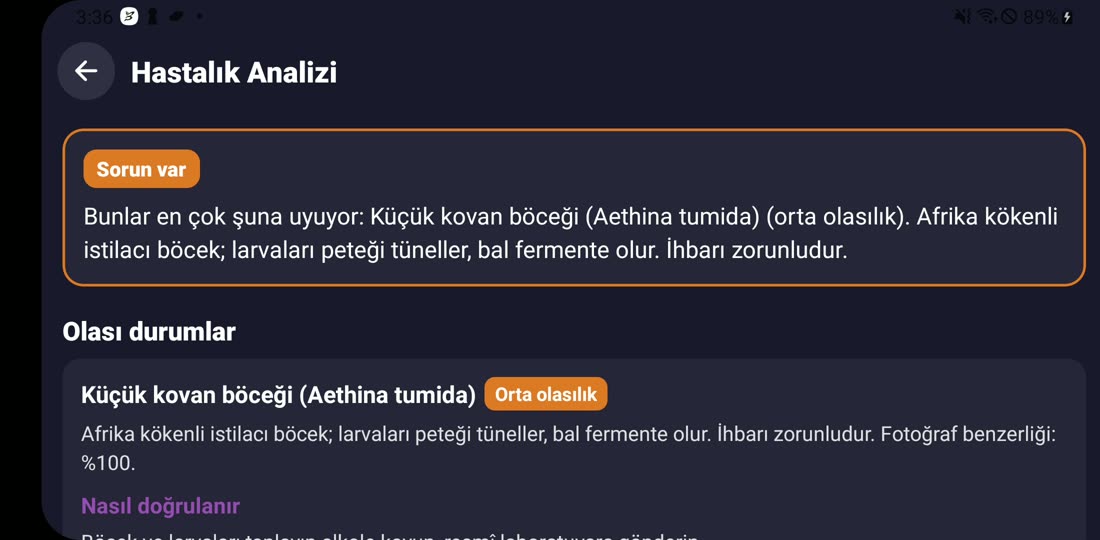
How it works
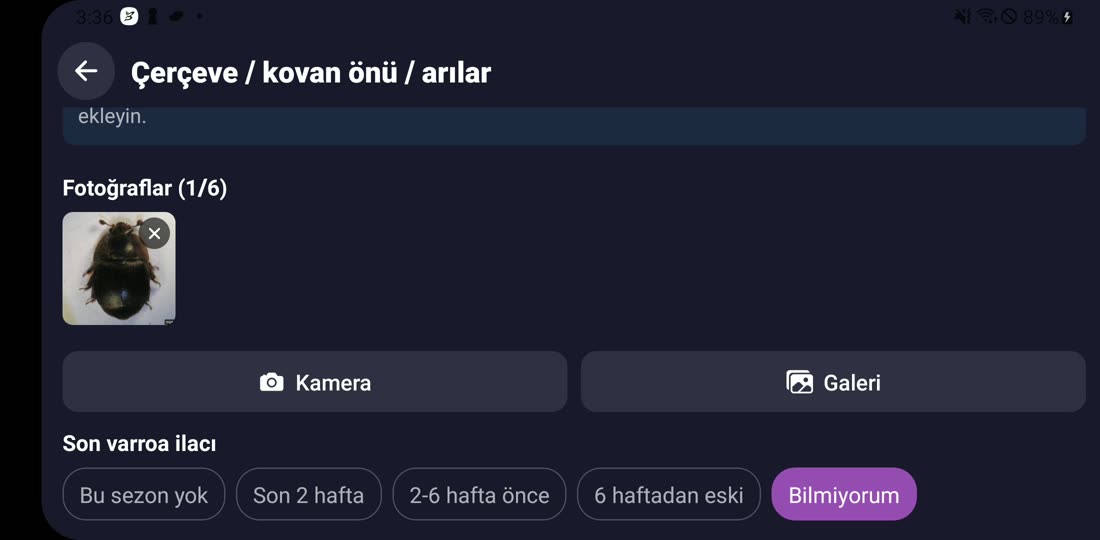
- Choose one of three ways: describe the symptoms by voice or text, add a bottom board photo, or photograph frames, the entrance and bees.
- Mark a few details such as the last varroa treatment; season and region are taken into account.
- Review the possible conditions, the differential diagnosis and the assessment updated with your answers; add it to the hive record.
What you get
Possible conditions and differential diagnosis
For each possibility you see why it is suspected, which sign sets it apart and how to confirm it.
Brood and adult bee diseases
More than 40 conditions are covered, including foulbrood, chalkbrood, sacbrood, nosema, viruses, varroa and small hive beetle.
Linked to the knowledge library
Symptoms and treatment of every possible disease are on its knowledge library page, in 9 languages.
Real screens from the app
Screens from the Turkish interface; the app works in 9 languages.
Frequently asked questions
Can bee diseases be recognised from a photo?
Some diseases have visible signs (chalkbrood mummies, deformed wings, beetles), so a photo helps a first assessment. Trembling or smell do not show in a photo; you add those by describing them.
How do you recognise American foulbrood?
Sunken, perforated cappings, larvae turning brown and a ropy thread in the matchstick test are typical signs. A laboratory confirms the diagnosis, and the disease is notifiable.
Which languages does it support?
English, Dutch, German, French, Spanish, Turkish, Russian, Arabic and Japanese; describe the symptoms in your own language.
First assessment of honey bee diseases
These tools are part of the BeesLike mobile app and are available to Pro members. The app is coming soon to the stores; your account is the same on the website and in the app.
Sign up freePro membershipRelated pages
Bee diseases and pests Varroa counting Breed analysis All app features
 We use cookies that are necessary for the site to work. You may also allow anonymous statistics cookies.