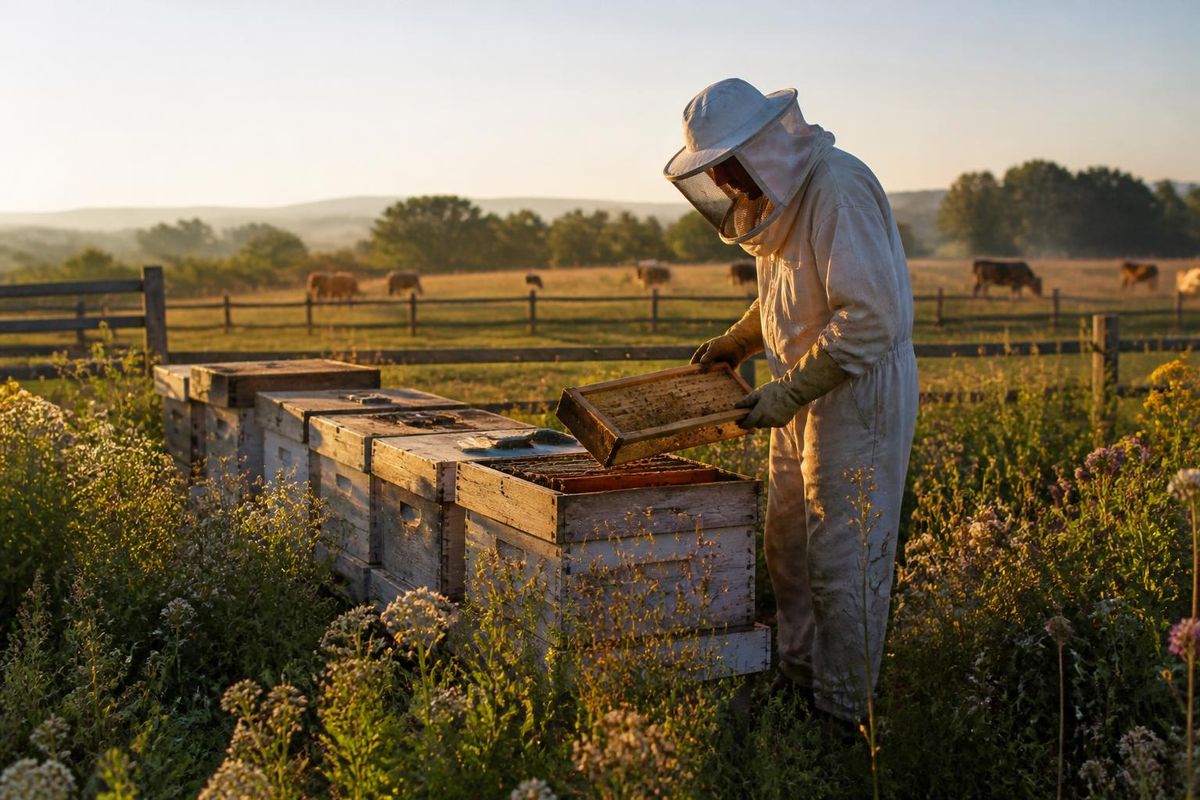
TOOLS AND EQUIPMENT USED IN BEEKEEPING Bee Hives and Their Features Among the most important…
🌐 Original language: Turkish
📰 Source: aricilikgazetesi.com.tr

- Bee Hives and Their Features
Among the most important tools and equipment used in beekeeping are hives, which are an indispensable input for apiculture. In nature, bees use tree and stone cavities as shelters (nests). However, with the development of beekeeping as an agricultural activity, bees have been placed in various shelters by humans. Throughout the development process of beekeeping, bee shelters have also been improved, leading to today's modern hives. The transition from the old system to modern beekeeping has been made possible by the use of framed hives.
Although in advanced countries old-style hives have completely given way to modern hives, it is still possible to see primitive and modern hives side by side in our country. Modern hives allow for beekeeping to be conducted under more favorable conditions and with greater ease. Additionally, the higher yield that can be obtained from modern hives, the ease of working in the care and feeding of bees, and the facilitation of bee transport for migratory beekeepers have led to the rapid spread of framed modern hives both in our country and worldwide. Hives can be classified into 3 groups as follows.
- Simple Hives
It is possible to encounter this type of hive in every corner of our country. These hives are simple in construction and appearance and are not suitable for technical and migratory beekeeping. They can be hollowed-out logs, baskets made of reeds or twigs plastered with mud or straw, as well as gourds, clay pots, simple wooden boxes, and even fruit crates used as hives. - Transitional Hives
Transitional hives represent the first step in moving from simple hives to standard framed hives and are situated between the two types. They are superior to simple hives in terms of being opened and inspected, honey harvesting, and other applications. Small framed hives made of four pieces of wood with covers at the front and back are among the most commonly used examples of transitional hives. - Modern Hives
Today, standard framed modern bee hives containing movable frames are used in many parts of the world and in our country. Although there are two types of modern hives, Langstroth and Dadant, Langstroth hives are more commonly seen in our country and worldwide. Both types of hives operate on the same system, differing only in dimensions. Modern hives provide significant advantages and benefits in technical beekeeping compared to other hive types. The benefits and advantages of modern hives can be listed as follows.
- All parts of the framed hive are movable, allowing for easy removal, repair, and renewal.
- They are more durable and long-lasting compared to primitive hives.
- All known beekeeping techniques can be easily applied in these types of hives.
- Colonies can be directed to produce honey or other bee products at any desired time.
- Feeding can be done as needed and in the desired manner.
- All kinds of diseases and pests can be managed as desired.
- The queen bee can be easily observed and replaced if necessary.
- Honey harvesting can be done at any desired time.
- They are ideal for migratory beekeeping.
- All parts of the framed hive are movable, allowing for easy removal, repair, and renewal.
- Langstroth Hive
In Langstroth bee hives, the brood chamber and honey super are of the same dimensions, making these hives suitable for regions with weak flora, short nectar periods, and warm, dry climates, as well as for migratory beekeeping conditions. In Langstroth type hives, the dimensions of the brood chamber and honey super body and frames are identical. A Langstroth hive contains a total of 20 frames, with 10 frames in the brood chamber and 10 frames in the honey super. The thickness of the hive body is 25 mm. The external dimensions of the brood chamber and honey super are 505 mm x 435 mm x 260 mm; the internal dimensions are 455 mm x 385 mm x 260 mm. The external dimensions of the frames belonging to Langstroth hives are 440 mm x 250 mm, with a frame shoulder width of 37 mm. The external length of the frame, including the seating allowances for the hive, increases to 472 mm.
1-Hive Cover, 2-Cover Board, 3-Honey Super, 4-Bottom Board, 5-Flight Board - Main Parts of the Langstroth Hive
Hive Bottom Board
This is the part located at the very bottom of the hive. The bottom board should not be fixed and should be easily removable when necessary. However, since migratory beekeeping is widely practiced in our country, the bottom board is made to be fixed. The flight board is designed to be hinged along the bottom board and can be closed. The flight board serves as a resting place for the guard bees and as a stop for bees that pump air into the hive by flapping their wings during ventilation. It also facilitates the entrance and exit of bees into the hive.
Brood Chamber
The brood chamber is the main part of the hive placed on the bottom board and has a flight hole at the front bottom. As the name suggests, the brood chamber is where the bees rear their young. It is also where the bees winter and store their winter food supplies.
Honey Super
This is the super placed on top of the brood chamber when the bee population increases and no longer fits in the brood chamber. Almost all of the honey to be harvested is taken from these supers. When the queen bee cannot find empty space to lay eggs in the brood chamber, she continues to lay eggs in the honey supers as well.
Frames
These are the parts of the hive placed side by side in the brood chamber and honey super, allowing bees to save time and effort by attaching foundation wax, resulting in increased productivity.
Cover Board
This is the internal cover placed under the hive cover. The cover board can be made in 2-4 pieces or as a single piece. For migratory beekeeping, a single piece is more suitable.
Hive Cover
This protects all the hive parts mentioned above and the bees. It can be flat or sloped backward. It prevents rain and snow from entering the hive. Especially in migratory beekeeping, it is necessary for the hive cover to have ventilation holes at the front and back.
- Simple Hives
- Other Beekeeping Equipment
- Bee Smoker
This is a tool that beekeepers continuously use during colony inspections to calm the bees and create a safe working environment. The smoker is generally cylindrical in shape and consists of three parts: the chamber (boiler) where smoke-producing materials are burned, the bellows that pump air to facilitate combustion and blow out the smoke, and the funnel-shaped mouthpiece through which the smoke is expelled. Materials such as sawdust, rotten wood roots, and straw can be burned inside the smoker. The material to be burned should not leave a scent in honey and beeswax. This is particularly important during honey harvesting. - Bee Veil
This is a headpiece that protects the beekeeper's head and neck from bees, typically worn like a hat made of fine mesh or wire. The veil should not obstruct vision and must be lightweight and durable enough not to cause discomfort to the beekeeper. There are types that only protect the head or the upper body, as well as those that can be worn like a suit. - Gloves
Made of thin leather or rubber, some have a fabric part that covers up to the elbow or wrist. Gloves are commonly used by novice beekeepers but are not often used by experienced beekeepers as they restrict finger movement. - Hive Tool
The hive tool is a very useful and commonly used tool, despite being a simple and small piece of metal. It is used for lifting the inner covers, removing frames, scraping and cleaning wax, propolis, or other debris, and separating hive bodies from each other. - Foundation Wax
It is a thin wax sheet made of pure beeswax with worker bee cells pressed into it, fixed to frames with the help of frame wire and a spur, to increase honey production and facilitate the bees in building comb. - Spur
It is used during the fixation of foundation wax to the frame wires. It consists of a handle and a toothed wheel attached to it, with the teeth shaped to allow movement over the wire. - Bee
It is used during the process of making holes in the side bars of frames for attaching the foundation wax wire to the frames. - Honey Knife and Capping Scraper
These are used to uncap the sealed honeycombs during the honey extraction process. Care should be taken not to damage the honey cells while uncapping. In some countries, the uncapping process is done with an automatic uncapping machine, significantly saving labor costs. - Frame Wire
It is a fine stainless and soft wire stretched between the side bars of frames to hold the foundation wax more securely. - Division Board
It is a flat board placed next to the last frame after compressing the honey and brood frames in weak bee colonies. The division board helps to reduce the internal volume of the hive, making it easier to maintain the necessary temperature in the brood area. - Queen Excluder
It is a metal grid placed between the brood chamber and the honey super to prevent the queen bee from moving into the honey supers. Worker bees can pass through the openings of the queen excluder, but the queen and drones cannot. It is generally used to produce high-quality comb honey. - Queen Bee Cages
These are special cages with various types used to introduce a new queen bee to colonies that are queenless or have an unproductive, deformed, or old queen, or to transport queens from one place to another. - Feeder
These are containers made from various materials such as zinc, plastic, wood, and fiberglass, used for feeding colonies with solid or liquid feeds. - Pollen Trap
During periods when bees collect abundant pollen, it is a trap mounted at the hive entrance or on the hive bottom to collect the pollen pellets brought in by worker bees. In recent years, types mounted on the hive bottom that can also serve as ventilation windows during bee transport are being used and recommended more frequently. - Honey Extractor
Also known as a centrifuge, the honey extractor is used to extract honey from uncapped frames. There are modern types that operate manually or electrically and have adjustable rotation speeds. The cylindrical honey extractors made of galvanized sheet or zinc consist of a cylindrical housing, special slots for placing frames inside this part, and a gear mechanism that rotates this slot assembly. - Honey Settling Tanks
These are containers where the extracted honey is held for a while to allow it to settle, during which wax particles and air bubbles rise to the top, purifying the honey.
- Bee Smoker
Read the full article at the source →
Source: aricilikgazetesi.com.tr
This page is a short summary of the article; copyright belongs to the original source.