



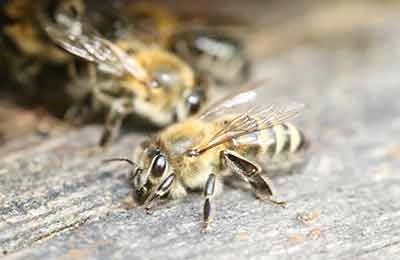
 The honey bee (Apis mellifera L.) is the most widespread representative of the genus Apis found in Russia. Using a multi-component analysis of morphometric traits, it is divided into four evolutionary branches [7]: A (Southern and Central Africa), M (North Africa and Western Europe), C (Northern Mediterranean, Central and Eastern Europe), and O (Mediterranean, Middle and Near East), which include 26 subspecies (Ruttner, 1992; Sheppardetal., 1997; Sheppard, Meixner, 2003; Meixneretal., 2011), and according to some data, 28 subspecies (breeds) (Engel, 1999). Some of them, such as A. m. mellifera, are further divided into differentiated local populations based on morphometric analysis results (Cornuetetal., 1975, 1978). Russian and Ukrainian scientists distinguish the Carpathian bee (A. m. carpatica) as a separate subspecies, although foreign researchers consider it a branch of the Carnolian bee (A. m. carnica)[3].
The honey bee (Apis mellifera L.) is the most widespread representative of the genus Apis…
🌐 Original language: Russian
📰 Source: beejournal.ru
Read the full article at the source →
Source: beejournal.ru
This page is a short summary of the article; copyright belongs to the original source.
More beekeeping news
 Honey has long been valued as one of nature's most precious gifts, holding a special place in…15.10.2026
 Jason Statham's most successful recent film is the two-year-old The Beekeeper, where he played…15.10.2026
 Cookies are used to ensure effective navigation and the operation of certain features on the…15.10.2026
 The Beekeeper 2 is a 2027 action thriller directed by Timo Tjahjanto and written by Umair…15.10.2026
 What can people learn from a bee colony15.10.2026
 The Kırşehir Provincial Directorate of Agriculture and Forestry teams are conducting intensive…15.10.2026